

Start Now
This is part of Start Now — a complete guide to building your own tax-free pension, published free, one piece at a time. New here? Start Here →
Greg M. Ostroff, CFA
START HERE
The Whole Plan - On One Page
If you read nothing else, read this. Everything after it is why it works and why you can trust it.
The five moves
DO THIS FIRST
If your job offers a 401(k) with a match, contribute enough to get the full match: that’s free money, and it beats everything below.
1. Open a Roth IRA. The one retirement account you can open yourself, no employer needed. Fidelity, Vanguard, or Schwab: about 15 minutes, no cost.
2. Put the money in one low-cost index fund that owns the whole U.S. market.
3. Contribute what you can every year, ideally the max ($7,500 in 2026), automatically.
4. Don’t sell. Ignore the headlines. Leave it alone for decades.
5. Start now. The earliest dollars are worth the most.
What it becomes
You’ll put into your Roth IRA about $322,000 of your own money. By age 70, entirely tax-free, that grows to roughly $2.2 million even in the worst 30-year stretch on record, and about $3.7 million in a typical one, an income of $86,000 to $149,000 a year. But the number that really counts is what those dollars are worth in today’s money: about $975,000 to $1.7 million, tax-free.
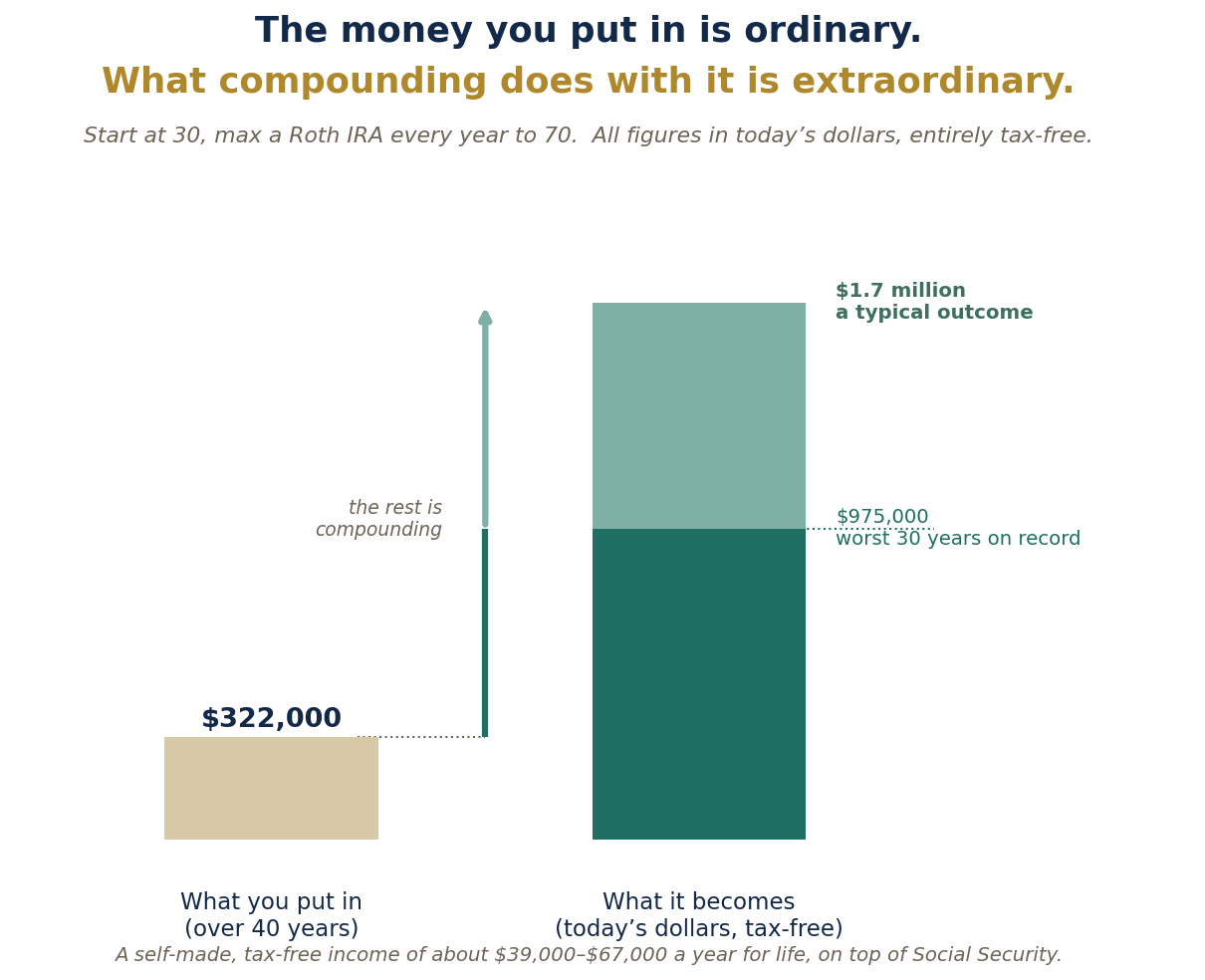
That’s the whole idea. Not a lottery ticket, not a fortune, a private pension you build yourself, tax-free, that makes work a choice instead of a necessity. Add that to your Social Security and you have your freedom.
✦
BEFORE YOU BEGIN
How to Read This Book
This book comes in two halves.
First, the Chapters are the book. Ten of them, an hour or two’s read, end to end, depending on how long you linger over the charts and tables. These Chapters hold the entire argument and everything you need in order to act on it: what compounding does, why the Roth beats the alternatives, what a lifetime of maxing one out actually produces, what could go wrong, and the simple routine for starting. If you read only this half, you have not read an abridgement. You have read the book, and you may stop with a clear conscience.
1. The Magic of Compounding: why growth crawls for two decades, then goes vertical.
2. Why Hold Investments in a Tax-Advantaged Account: tax-free growth that, for most savers, outdoes both taxable and traditional accounts over a lifetime.
3. Case Studies: A Lifetime of Maxing Out an IRA. The full range of results, from the 8% floor to the 13.6% ceiling, in both nominal and today’s-dollar (inflation-adjusted) terms.
4. It Pays to Start Early: the measurable price of every year you delay, and why it’s never too late to start.
5. A Middle-Income Investor in a High-Tax State: The California Example. The plan run for a typical ~$100K earner, where state tax makes the Roth’s edge larger still.
6. Why This Falls to You: how retirement landed on the individual in America, and how Social Security and a Roth combine in retirement.
7. A Family Strategy: Gift-Funding a Young American’s Roth. How to give someone just starting out a head start.
8. What Could Go Wrong? A clear-eyed look at the risks to this plan.
9. What Could Go Right? The upside we deliberately left out of every number, so the surprises run in your favor.
10. Putting It Into Practice: the final chapter turns all of this into one simple routine: open a Roth, fund it as early as you can each year, invest it in a single low-cost broad-market index fund (we offer ideas later in the book), and leave it alone.
Second, the Deep Dives are the evidence. Ten of those. Read straight through, they take a little less time than the Chapters do. This is where the work is shown. Every number gets its arithmetic, and every serious objection gets a chapter of its own rather than a sentence. Can a century of market history be trusted at all, the floor as much as the average? Were Japan’s “lost decades” really lost, and who actually lost them? Why did America win, and can it keep winning? And what is the one real decision all of this leaves you with?
And one word about the numbers. The large dollar figures throughout are an illustration of a financial principle, not a savings target. You do not have to start young or contribute the maximum, though it helps, and the same forces work on any amount, begun at any age. The figures come from historical market returns. Markets, taxes, and inflation all change, and the next 30 years will not look exactly like the last. But those returns have held remarkably consistently for a very long time, which is a real source of comfort. Read them as a demonstration of why starting early matters, and scale them to your own life.
A note about the vocabulary. Where a financial term earns its place, the Key Terms section in the very next post in this series defines it in plain English, so you never have to leave a page confused.
One thing worth saying plainly: the Deep Dives assume you have read the Chapters. They are the defense of an argument, not a restatement of it, and they will not make much sense on their own. So read the Chapters first. That is the book. Then, if you want to know whether all of this survives contact with a skeptic, the second half is waiting, best read in order, though each Deep Dive also stands on its own.
One thing to carry through all of it: every conclusion here is built on the worst long-term performance the U.S. stock market has delivered on record. The deck is quietly stacked in your favor, because every other outcome on record is better than the one we planned for.
You do not need a financial advisor, a windfall, or a big salary. Open an account, contribute what you can, invest it, and leave it alone. Every year you wait is a year of compounding you can never recover.The tools are sitting in front of you.
Start Now.
A NOTE FROM THE AUTHOR
Start Now is free to read and free to share. If it helped you, the kindest thing you can do is subscribe and pass it to one person who needs it. Questions, comments, or a story of your own? Leave one below, or just reply to this email; I read every one. If you’d like to give back, pay it forward: donate any amount to a cause you believe in. I don’t collect a penny of it; it goes straight to the charity you choose, not to me. If you’d like a suggestion, I support the Zach Moses Music, Love & Light Fund at the Sweet Relief Musicians Fund, which feeds musicians in need. sweetrelief.org/zachmoses →
Coming next: Key Terms